Transformation
- Home
- Type-informed Tapping
Type-Informed Tapping: How Enneagram Insight Sharpens EFT
Reading Time: 9 minutes
Let me introduce you to Type-informed Tapping where the Enneagram and EFT augment each other to really make a difference to your growth work.
If you’re already into tapping, you’ll be excited to achieve a whole lot more when you understand how to use the Enneagram.
 Type-informed tapping helps you move from surface symptom to the deeper pattern underneath.
And if you’re already into the Enneagram, you’ll be amazed at how many behaviours and beliefs you can shift with EFT!
Both the Enneagram and EFT can be oddly frustrating for intelligent, self-aware people.
You have absolutely no problem acknowledging your behaviours. You can name your feelings. You can tell your story, and you can see how you got here.
But your efforts at change seem to be stalling, and your tapping still feels like it’s staying on the surface.
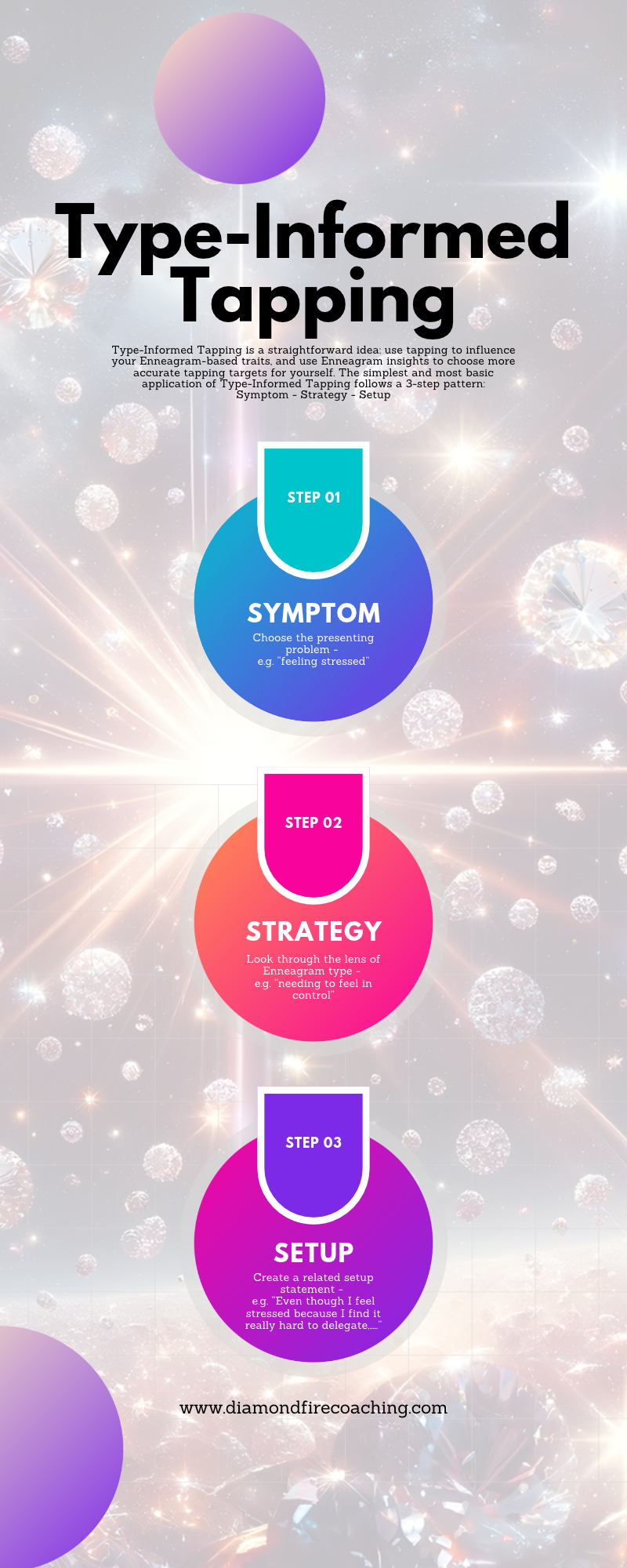
Type-Informed Tapping is a straightforward idea: use tapping to influence your Enneagram-based traits, and use Enneagram insights to choose more accurate tapping targets for yourself.
But don't be fooled. Even though the idea is simple, it's actually the gateway to an incredible depth of personal exploration!
The question is: how far do you want to go? :)
If you’re kinda new to self-development work, you’ll want to start with the most basic application of Type-Informed Tapping:
Symptom -> Strategy -> Setup
You still tap on the presenting problem (symptom), but you view it through the lens of your type (strategy), so that you can use tapping language (setup) that connects directly with the part of you that is being defended.
A really basic example would be tapping because you feel stressed.
You might say that your symptom was “feeling stressed”, or you might dig a little deeper and say that your symptom was “tension in my neck”, or deeper still - “I don’t think my colleagues like me”.
But when you look at the symptom of stress through the lens of each of the Enneagram types, you realise that there are specific things that will either cause, or contribute to, stress for that type.
On some level, Marcia already knew that her stress was probably due to the sheer size and weight of the workload she was carrying. But she felt she couldn’t really trust anyone else to do the tasks as well as she could.
“They never seem to do things properly, even when I give them clear, written instructions.”
Through the lens of Enneagram Type 1, Marcia realised that she was deeply motivated to be in control in any given situation.
The idea of delegating tasks to others is actually counterintuitive to a Type 1.
By looking at her issue through her Enneagram type, Marcia realised there was a need to shift from having control to letting go.
That is a BIG ask for a Type 1 but by introducing the idea in her tapping statements, she could begin to relax a little and (more importantly) she could start to see new areas to explore in her personal growth work.
Marcia had found that she really enjoyed tapping with affirmations, so she began by tapping on statements like “Even though I feel stressed because the work is not up to my standards, maybe I can begin to accept that it is good enough as it is.”
Or “Even though I feel stressed because I find it really hard to delegate, maybe I can allow myself to recognise that my way is not the only way to do things.”
But if she had wanted to do deeper work and use more effective EFT protocols, she could then begin to look for specific instances where her life had been impacted by her need to do things ‘properly’.
Tapping targets by Enneagram type
It is well established that the more specific you are with your tapping target, the more success you are likely to have.
If your tapping seems to have got ‘stuck’, it’s often because the target is too generic - I feel anxious, I feel stressed.
But when you know your Enneagram type, you’re aware that a part of you is trying to protect you from feeling or experiencing something.
Every Enneagram type has an automatic compulsion — “I must”, “I have to”, or “I can’t” — underneath their surface reaction.
By tapping on the underlying driver, you will begin to have more connection with what’s really going on.
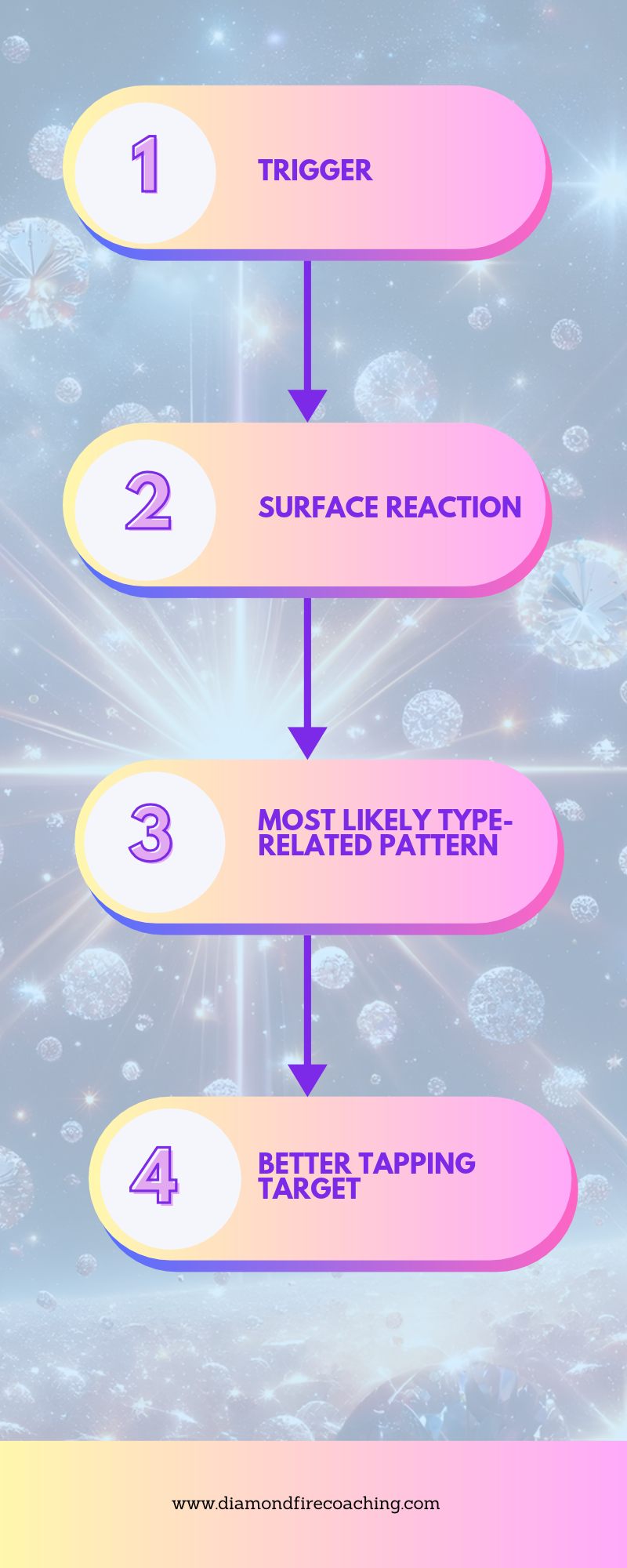
For example, when an Enneagram Type 1 like Marcia recognises the need to stay in control so that things are done the right way, she can change the focus from the symptom (feeling stressed) to the strategy (needing to stay in control).
She can now reformat the setup from “Even though I’m stressed,…” to “Even though a part of me believes that I have to stay in control so that I can feel okay,….”
When we are open to using the Enneagram as a guide to our defensive strategies, it becomes a source of potential tapping pathways to use if you feel stuck.
So notice your reaction to a situation (symptom), use your Enneagram knowledge to consider what protection you might be using (strategy), and use that to improve your tapping target (setup).
Enneagram motivations as EFT language
A common mistake when creating EFT setup statements is to stay at the level of feelings without digging deeper to the level of motive.
Remember that feelings tell you what hurts, but examining motives tells you what you are protecting, defending, or avoiding.
In addition, when you know your Enneagram type, you have a further insight into your core motivation(s), and when you’re ready for deeper work, tapping with your core motivation in mind can open additional routes to explore.
Using type-informed statements may seem like a longer way of doing things, but they are truer than shorter surface-level statements, and that is what is most important in creating successful tapping targets.
Compare the following setup statements:
Generic: Even though I feel overwhelmed, I accept myself.
Motivation-based (Type 7): Even though I am overwhelmed because I think it is my job to be happy all the time and I can’t let my friends see that I’m down, I accept myself.
Or:
Generic: Even though I am angry, I accept myself.
Motivation-based (Type 1): Even though I am angry because I feel responsible for all of this, and I cannot let it go, I accept myself.
When you drill down to a statement that is motivation-based, you can stop relying on non-specific tapping scripts, and actually start to target the ‘raw nerve’ that is being triggered.
This, in turn, gives you a clearer sense of where you are at and where you are going with tapping.
Angela asked for my help because she felt stuck with feelings of overwhelm while trying to create a presentation at work.
When I asked her what setup statements she’d been working on so far, she told me she had found a free tapping script online.
As I expected, it had made her feel better in the short term, but it wasn’t getting to the real issue: why she was feeling overwhelmed.
Knowing she was a Type 5, I suggested she try using the core motivation of a Type 5 in her tapping setup, just to see if it opened any doors for her.
Type 5s will do anything to avoid looking or feeling stupid, so we experimented with “Even though I feel overwhelmed at work, and it might have something to do with a fear of looking stupid...” and bingo!
Angela realised that she was actually creating more and more work for herself through her efforts to know everything about her topic, rather than staying focused on what was required.
Working with type defences in EFT
Even good targets can feel inaccessible when defences are active. In sessions, defences often look like:
Type-informed tapping treats this as information, not failure.
 What looks like resistance may actually be useful information.
Instead of pushing past the defence, you can tap on the protective move itself:
“Even though I am going blank, part of me believes it is safer not to feel this.”
“Even though I keep explaining, I do not want to be misunderstood.”
“Even though I am minimising, I am trying not to be a burden.”
“Even though I am analysing, I am trying to stay in control.”
This is where the symptom -> strategy -> setup sequence matters. The defence is not a detour. It is often the clearest doorway to the underlying pattern.
One important thing to remember: when you feel that you’re coming up against some form of resistance, check to see if you’re simply reverting to an old defence strategy.
When Sharon began coming for tapping sessions, she was highly resistant to what she perceived as “EFT focusing on the negative”.
I explained that with EFT we are trying to find the “raw nerve” so that tapping can calm it down, but she still wasn’t entirely happy with the seeming negativity.
I asked her what setup phrases she used when she was tapping on her own and noted that she always concluded her setup with a positive statement: “Even though I feel sad, I choose to feel happy”, or “Even though I am scared to do this presentation, I know that I can do this”.
It became clear that Sharon felt that positive thinking was an essential part of resolving every issue.
I began to suspect that she may be an Enneagram Type 7, so I asked her to consider the possibility that staying positive could be a protective strategy.
Instead of tapping on current issues, we chose to explore the defence: “Even though I’m avoiding negative feelings, part of me feels safer by staying positive”.
This allowed Sharon to be open to tapping setups that were closer to her truth in any given moment.
Reframing setup phrases by type
A powerful way of improving your use of the Enneagram with EFT is to move from identity statements to pattern statements.
If you use identity statements, there is always a risk that the mind will fixate on these as absolute truths:
“Even though I am a people-pleaser…”
“Even though I am avoidant…”
“Even though I always sabotage…”
By developing type-informed tapping reframes, you can keep the focus on the current mechanism and remain open to the possibility of change:
“Even though in this moment I am scanning for what others want from me…”
“Even though right now I am pulling away because closeness feels demanding…”
“Even though part of me is bracing for disappointment and wants to quit first…”
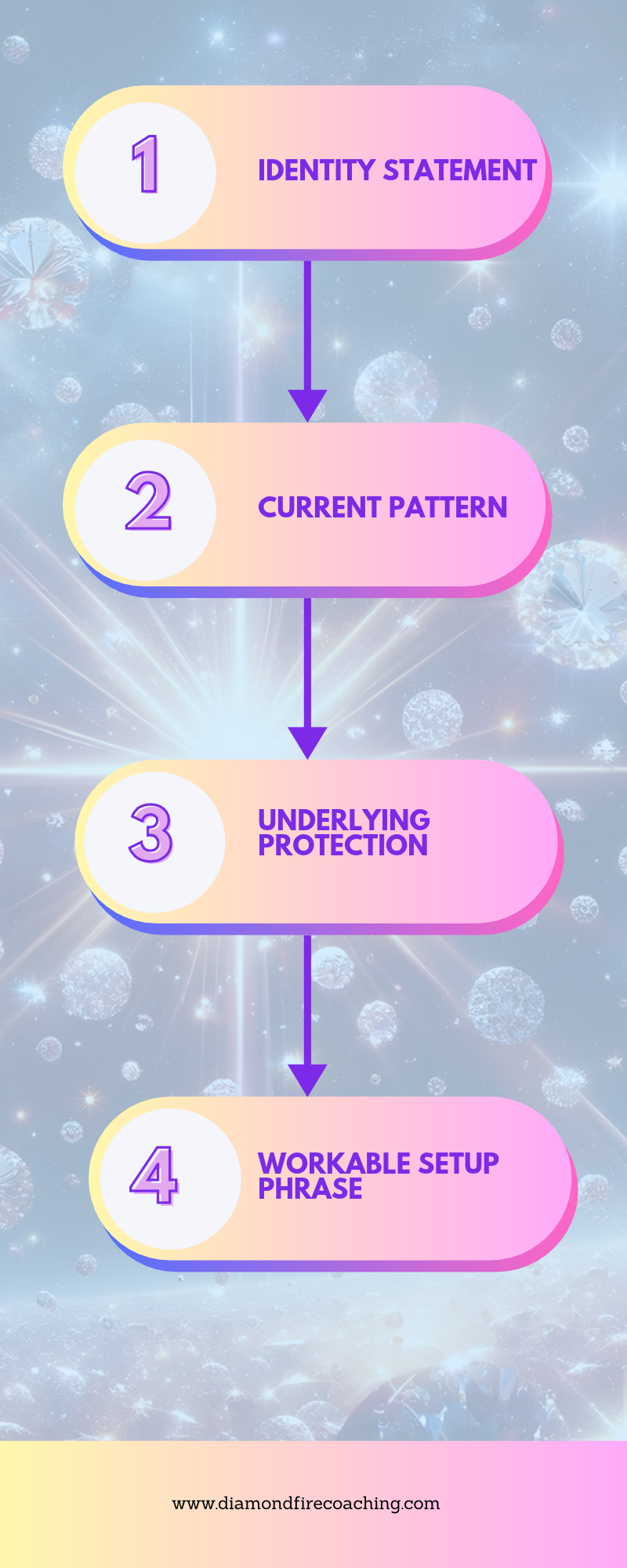
You can think of this as a four-step process:
 The goal is truer phrasing, not harsher phrasing.
1) What is the identity statement associated with your Enneagram type?
2) Reframe it to take account of the pattern you are running in the current moment
3) Consider what the behaviour is trying to protect
4) Now use steps 2 and 3 to create a workable setup phrase
Working in this way means that your Enneagram insights are useful without becoming a judgemental self-definition.
Remember that when we choose to be more specific with setup phrases, we are not trying to be harsher with our honesty.
Our goal is always to make direct contact with what is true now.
Tapping reinforces type story
A real risk with combining Enneagram and EFT is accidentally rehearsing your type narrative.
 Use type as a lens for targeting, not as a label for who you are.
If you end every tapping round with “that is just my type,” you may get lots of insight but miss out on real change.
Remember that when it comes to tapping, we are using Enneagram type as a targeting lens, not a life sentence.
With that in mind, here are some tips that will keep your work active and moving:
When creating a setup phrase, treat your Enneagram type as a hypothesis and not a final verdict. If your first attempt at a setup phrase does not land, change it.
Keep your language within time boundaries. Use phrasing like “in this moment,” “right now,” or “a part of me.”
Aim your tapping at the defence mechanism, not your character: consider what using this strategy is doing for you?
Watch out for feeling soothed simply because you have an explanation for your reactions. Check whether anything actually shifted in your body.
Success with Type-Informed Tapping
Success with type-informed tapping is often less dramatic than a major breakthrough. Instead, it may simply show up as a feeling of less urgency, less compulsive mental looping, and more choice.
Type-informed tapping is about getting in touch with the pattern underneath the symptom, and then working to release it.
When you know your Enneagram core motivation, it becomes easier to focus your tapping at the behavioural level.
If you add in an awareness of your Instinctual Drive, you can open up whole new avenues of tapping exploration at the level of belief.
And when you pinpoint your DiamondFire, you can elevate your tapping to issues of identity.

Helen Devlin is the founder of DiamondFire Coaching.
She has spent almost 30 years writing and teaching about authentic transformation, EFT, the Enneagram, emotional healing, and personal growth.
Her work focuses on helping women to move beyond repeated inner patterns and to reconnect with their true selves through an integrated, experience-based approach.
